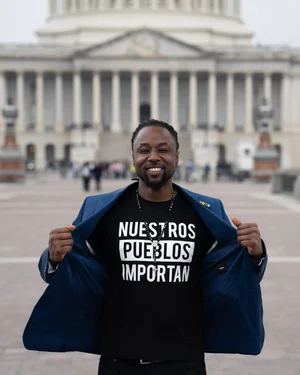
Somali Day at the State Capitol comes after a challenging several months for community
Community leaders and state leaders gathered in the Capitol rotunda Monday morning for the third annual Somali Day. It comes in the wake of “Operation Metro Surge,” which the Trump administration initially described as an effort focused specifically on deporting some Somali Minnesotans.
Fartun Weli is the CEO and founder of Isuroon, one of the organizations supporting the event. Weli spoke to Minnesota Now host Nina Moini about the significance of the event this year.
Use the audio player above to listen to the full conversation.
Subscribe to the Minnesota Now podcast on Apple Podcasts, Spotify or wherever you get your podcasts.
We attempt to make transcripts for Minnesota Now available the next business day after a broadcast. When ready they will appear here.
Audio transcript
NINA MOINI: Community leaders, state leaders are gathered in the Capitol rotunda this morning for the third annual Somali Day. It comes in the wake of Operation Metro Surge, which the Trump administration initially described as an effort focused specifically on deporting some Somali Minnesotans. One of the co-hosts of the event, Sulieman Adan, spoke about why this year's event feels different.
SULEIMAN ADAN: If you look around the room today, a lot more people would have been here. Leading up to today, Monday, like I mentioned before, even though I was graduating from the Chicago Theological Seminary, I was on calls, calling people from Owatonna and Faribault and Mankato and Rochester, each of them wanting to be here, each of them having legal status to be in this country.
However, they also have neighbors and friends who were picked up from an apartment not far from the Capitol, from the McKnight Buildings here in St. Paul, in the dead of night, taken from their apartments in St. Paul to the federal building, and then on a plane to Texas. Some of them were brought back a week later. Some of them are still there. Their families still trying to figure out if they're in Texas or Nevada or Louisiana.
So we ask ourselves. We are being told that ICE is no longer here. We are being told we have no longer a need to protest. But I'm here to tell you today that even though we do not see them in their masks on the streets of Minneapolis and St. Paul, their presence, the effect that they've had in our community, and their impact will be felt for forever to come. And this is why we need to support not just the Somali community here in Minnesota, but Somalis all over the country and organizations like SAC, the Somali American Coalition, that are making this work possible.
NINA MOINI: That was Sulieman Adan, one of the co-hosts of the Somali Day event, speaking there from the Capitol rotunda. Now, we have on the line Fartun Weli, who's CEO and founder of Isuroon. Isuroon is one of the organizations also supporting the event today. Thank you very much for being on with us, Fartun.
FARTUN WELI: Thank you for having me.
NINA MOINI: We were just listening there to some of Suleiman Adan's reflections on this time. What was it like today at the State Capitol? What kinds of conversations were you having with other community members and lawmakers during Somali Day?
FARTUN WELI: Well, what Suleiman was saying is, so to the point where when issues like this happen, which it didn't happen to us, I always remind myself, well, who are we? Minnesota's Somali-American community. 87% of us vote. I've been door-knocking before I even could speak English. So civic engagement is so critical. Entrepreneurs, the workforce, the taxpayers-- we've been here 26 years. And I think first generation was maybe 30, 35 years.
We've been on the ground working, building our lives and the future of our kids and the next generation. So we didn't think or never had an idea that we would be under this attack. And so we really didn't know what to do. So right now, we're using our assets. We're coming together. We're going to the legislature and saying, hey, we're not this burden. We're giving so much, and we're doing so much. And this is who we are.
And I wanted to congratulate SAC and their leadership over the incredible work that they're doing for the capital. And so the key point is, when our families, the young generations, the immigrants, those who are citizens, there was a complete shutdown of no one going to work. And so many of our families have slide down into poverty. And that's not the reason we came to America or Minnesota.
So the legislators, people who are allies, we're telling them, listen, would you rather pay more welfare checks to our families, which I completely want our families to get out of it, or live in a fear and domestic terror issues. We need to get this thing better. And what I want to also say is how incredible, proud of Minnesotans I am, how Minnesotans showed up for us and with us. And I'm just incredibly proud to be Minnesota Somali-American.
NINA MOINI: What was it like the past few months? I mean, you mentioned some people missed paychecks, missed work, were hiding in fear, even people who are United States citizens, as you mentioned, the overwhelming percentage of Somali Minnesotans are. What else did you see in terms of impacts on people, whether it be emotional or social? Like, how big of a deal was this time?
FARTUN WELI: It was a big deal. Again, majority of us came here with a green card. And but my job was also never seen this kind of a direct attack. Somalis are many ethnic and refugees and immigrants were very social. We support one another. We are close to each other. And it almost felt like they really studied our assets and our strength, which is social connection. And that's what I attracted to us. They cut the communication out. There was no planning. There were no way of having connecting with us.
So the first couple of weeks, we had women who were in dialysis. We had women who were in labor that wouldn't go to the hospital to have the babies. And we used our allies and our relationships to get them to the hospital, get them to support. Our food shelf, we have three locations. We usually give out 300 families per week. That moved into 2,500 a week.
NINA MOINI: Wow.
FARTUN WELI: Fellow Minnesotans were coming from everywhere, too.
NINA MOINI: So as you were at the State Capitol today, I understand this was the third time that the event was taking place. Obviously, this last few months has been incredibly difficult, it sounds like, in many ways. What were you talking to lawmakers specifically about, I wonder? What are you asking them for?
FARTUN WELI: I'm actually not at the Capitol. Three of my colleagues are there today. But I'm on the phone with our legislators. And what I am telling them is, hey, listen, this community, we're talking about so many-- why Somalis are under attack. When you flip the site and really look at the reality is, we're contributing to this great state. Don't pick on us. Our families, our children, our elders, our seniors, we are here. We're taxpayers.
What mistakes have been, we know we need to correct it. But you can't just put a policy just because of a policy. And we're saying we need our funding. And we need our relationships. And get to know us. That's what we were saying to them.
NINA MOINI: Fartun, I appreciate you sharing because I know it must be hard after living here for more than 20 years and contributing to be still-- or for the first time, for some people perhaps, having to prove that you are a contributing member of society and feeling like you have to earn your place after all of this time of contribution. But I do want to know what brings you hope, as you look around at the different generations of Somali Minnesotans and how far, like you mentioned, that people have come. What gives you hope on a day like today?
FARTUN WELI: Well, I've been here 26 years, Minnesota. What gives me hope or actually gave me hope was, A, how Minnesotans showed up. My ESL teacher, Ellen Lewin, was on the street, supporting. She was my ESL teacher 26 years, but I've seen her. How Minnestoans showed up, the incredible support and asset. The other thing that gives me hope is Somalis are incredibly resilient individuals, community members. And this may be a new issue to us, but we always come out winners.
The third thing that gives me hope is our first generation, like mine, we pour ourselves in second generation, and they're all graduating colleges. They're incredible, intelligent, smart people on the ground. And so we have everything that we need. And our faith is also important. That gives me hope. Every challenge brings an opportunity to do better, and we will do better.
NINA MOINI: Fartun Weli, thank you very much for your time. I really appreciate it.
FARTUN WELI: You're welcome.
NINA MOINI: That was Fartun Weli, the CEO and founder of Isuroon.